Showing posts with label Math. Show all posts

Saturday, February 5, 2011

How much you can suck at aiming a ball


In the sports of Basketball and Soccer your goal is to get a ball into a net. I've decided to calculate the number of degrees that you can make the shot within while still having the ball going into the net.

Soccer
*This assumes a 24 ft wide net and that you are in front of one of the net.
F(x) =  57.3(8/x)
Where x = distance from net in yards
("8/x" calculates radians, and multiplying by 57.3 converts that to degrees)

This outputs roughly:
05y: 91.7 deg
10y: 45.9 deg
15y: 30.6 deg
20y: 22.9 deg
25y: 18.3 deg
30y: 15.3 deg
40y: 11.5 deg
50y:  9.2 deg

As you can see, the further you get away from the net the substantially harder it is to make sure that you're shooting within the right range.

Basketball
*This assumes a 17" hoop, 9.4" ball and that you are aiming for the hoop, not the backboard. I am also considering the range in which the ball can hit the rim and still go in, which makes the arc that you can shoot into roughly 14.3" wide.
F(x) = 57.3(1.2/x)
Where x = distance from hoop in feet
05 ft: 13.8 deg
10 ft: 6.9 deg
15 ft: 4.6 deg
20 ft: 3.4 deg
25 ft: 2.8 deg
30 ft: 2.3 deg
FREETHROW: 5.3 deg
THREE POINTS: 3.5 deg 

Ok, so if you play basketball and know what percentage of the time you make Freethrows you could theoretically calculate the amount of times you will land three pointers. Neat, huh? Just run this function:
F(x) = 3.5/(5.3/x)
Where x = percentage of time you make a freethrow (without the backboard) in decimal
Note: If you replace 3.5 with the degrees from another distance your result will correspond to that one.


Trigonometry sucks.

Monday, January 31, 2011

Exponents and Imaginary Numbers

I made this flowchart as a means of handling the different exponents that could be on (i). Just fill in for (x) and follow the flowchart to get your answer.

When should I go to bed?


Seeing as it is the end of the weekend I would love a believable excuse for staying up later than usual even though I still have to wake up at 8:00. So I let math convince me. This series of functions I formulated will let you deduce when you should go to bed:

First you will have to convert the time you woke up and the time you will be waking up tomorrow into a different format:

F(v,u) = 60v + u
Where: v = hours (military), u = minutes

I woke up at 2:30 so that equals 870 and I plan on waking up at 8, which equals 480. Now you will have to figure out what the time to go to sleep will be in the same format:

G(w,x) = x - [(1440-w+x)/3]
Where: w = time you woke up (converted), x = time to wake up (converted)

1440 - 870 + 480 = 1050
1050/3 = 350
480-350 = 130, which is the time I will be going to bed

H(y) = └y/60┘ , y - (└y/60┘ * 60)
Where: y = time to go to sleep (converted)

My answer would be: 2 , 10
The time I'm going to bed. :D

Btw: └3.23┘ = 3
It just removes the decimal place/fraction.

Wednesday, January 19, 2011

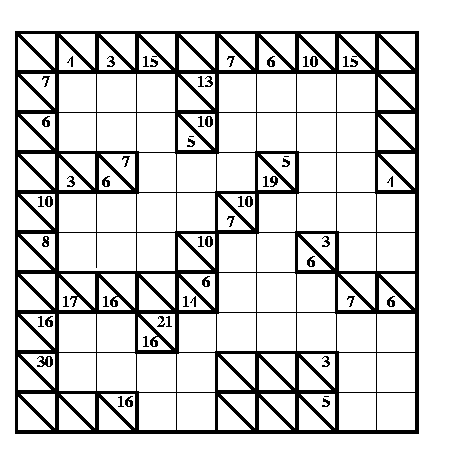
Kakuro Puzzles

I've always been a fanatic of puzzles and riddles, and eventually that led me to discover Kakuro. I enjoy Kakuro due to the mathematical and logical synergetic nature. I also enjoy the sense of superiority when I compare it to a popular yet very simple puzzle, Sudoku ... which Mindona does. ;D

This is an example of an easy Kakuro puzzle. The objective is to saturate the grid with the numbers 1-9 while making certain that you do not use the same number twice in a given row or column and that all the numbers within a given row or column add up to the given total. Now look at the upper left where you see two rows both with three square. The only way to fit three integers into six is by using the smallest available (1, 2, 3) and to fit three in seven you substitute the three for a four (1, 2, 4). Next, we'll look at the column that calls for two numbers that add up to 4, which will be 1 and 3. Seeing as 7 cannot host a 3, we can tell that a 1 will go in the top box and a 3 will go in the bottom box. Rinse and repeat until solved.

While ones like these are excellent for beginners, do not fear that the difficulty caps off here. There are many puzzles which will require you to look numerous steps ahead in order to deduce which numbers should go where.

I generally do these while eating breakfast and during any periods in which I find myself doing nothing else productive ... such as waiting for Mindona to finish up in the locker room. ;P