Showing posts with label Intelligence. Show all posts

Sunday, October 9, 2011

Schedule Optimization

"The key to success is motivation. The blueprint to success is organization."
-Gary Shikora


Opportunity cost is the price encountered when one decides to do one thing and is thus unable to do the next best alternative. I define Schedule Optimization as the process in which one attempts to use their time in the way that results in the least opportunity cost. The concept of opportunity cost is frequently used in not one, but two models. I will temporarily refer to these two models as (1) the exchange model, and (2) the time model. I find one of these models to be primitive. In any case, I would do well to illuminate what I mean by the two models.

Let the exchange model of opportunity cost be used for exchanges. Let there be two parties. When these two parties are to trade goods they must consider if they are using their resources optimally. Lets say there is another party. This new party offers the first party a finer deal than the second party. The second party is rejected and the first and third parties undergo trade. The objects of trade can be anything of wealth, i.e., anything we value. The reason why the first party opted to trade with the third party is because the third party offered more wealth to the first party. As such, the opportunity cost of trading with the third party was less than the opportunity cost of trading with the second party.

Let the time model of opportunity cost be be the process in which one makes a decision to better their lives, with their lives being the set of all time they are sentient. One may quickly make note that one must decide to make an exchange. Yes, it is then true that the exchange model preforms only one of the many functions of the time model. Furthermore, the time model has the capacity to be used within the realm of one's personal productions, extending it's authority to all possible living human phenomena. Let us now assert that the exchange model is totally worthless as it only looks at a very narrow part of the opportunity costs we all endure, and move on to explaining the possible situations of living human phenomena.

A very simple rendition of the processes of a given human would be: Sensory input leads to internal learning functions which result in outputs. Because one is constantly queued to make some sort of action, we can determine that all individuals decide at the margin. We can also assert that margin extends for what we call a moment. Now, within each of these moments a human decides what to output. When making this decision they are - consciously or not -  determining their opportunity cost. I assert there is a dichotomy of the decisions a human can make. One category shall be contemplated decisions, with the other category being decisions not completed. The two categories should be handled very different for schedule optimization.

Before moving onto the complexities of contemplated situations I will first assert that decisions without contemplation are much easier to facilitate. That is, there are two very direct ways to improve decision making without having to contemplate decisions. The first method is through good health. The second method is through conditioning. I assert that the more one becomes familiarized with a given subject the easier thought becomes on that topic. I would attribute this phenomena to the concept of intuition. The concept of intuition shall be defined as the process in which a human rapidly comes to a decision by recomposing past ideas. Exampli gratia: the more one reads economic textbooks then the less time they will have to spend consciously thinking in order to produce a decision related to economics to the point in which no time is spent consciously thinking at all. Furthermore, I believe one can build an intuition for building intuitions. So, to optimize a given area of decisions made without conscious thinking you must build an intuition for that given area of decisions. What about decisions made with conscious thinking?

Decisions made with contemplation require a lot of work to optimize. I will assert that the optimal understanding of a decision is when the decision can be made both accurately and intuitively. However, when building an intuition one is faced with their conscious. When communicating with one's conscious I think it is very important for one to remain open and to not take themselves too seriously. Any other way and one may very well establish an intuition that is not sound or accurate. It is much harder to learn things once learned wrong than to learn things not learned at all. I digress, when handling one's conscious one must be very keen on weaknesses. If we assert that an intuitive understanding for something is a strength, then any lack thereof would be a weakness. If one is able to locate and eradicate these weaknesses at some positive rate, then they will be able to move toward an intuitive understanding.

Finally, there is a category of contemplated decisions which are just so freaking complicated nobody has the time to intuitively understand them. Rational ignorance. With these sort of subjects comes the heavy labor of schedule optimization. Humanities primary method of retaining and building ideas that cannot be readily produced is to immortalize the ideas with symbols, namely language. I am by no means qualified to tell anybody how to organize their ideas, but I am able to express how I handle mine. When I want to handle ideas I don't wish to commit to memory I think of one thing: technology. The goal of technology is to minimize production costs, and there just so happens to be plentitudes of technology available that would minimize almost anybody's personal production costs ....

1. GOOGLE CALENDAR "Free"
-I think this is like the best thing ever for people that are constantly moving/have something to do. I hate having to remember when everything is due, when that dance is, who I need to see tomorrow, so with Google Calendar I gleefully abstain from any such duties. Google Calendar allows one to create recurring events, which is why I opted for it over other calendars I could have chosen.


2. Smartphone/Tablet Pretty expensive
-The smartphone/tablet PC is becoming more popular than 'conventional' PCs. For good reason. Without my smartphone I wouldn't have constant access to countless news feeds, Wikipedia, The World Factbook, Google, Wolfram, and Dictionary.com. All these internet technologies are very essential to expediting the expression of ideas. If one hasn't the ability to readily pursue their thoughts then they are bound to forget at least some of them.

3. Notecards Becoming peculiarly more expensive
-I like to carry a couple notecards in my pocket because I am a student. More specifically, I hate taking notes but I love listening to lectures. However, there comes certain times during lectures when I wish to pursue more information, but can't take my iPhone out and do so, because I am listening to the lecture. In these cases I write down on a notecard a couple things. The first thing is what idea I am interesting in pursuing. The second thing is the way I plan on pursuing it, be it the book for the class or a simple Wiki search.

4. A Briefcase Like 50-100 bucks, but who carries a briefcase?
Ok, so it's kind've a weird fashion statement that a lot of people probably just don't want to make, but a briefcase is an amazing tool for organization. There are plenty of alternatives like backpacks, purses, satchels, binders, etc, but briefcase has been my favorite because I am able to neatly organize and readily access my belongings in a single compartment. Furthermore, I hate wearing backpacks.


5. Good Friends Is it ok to be calling humans technology? No, really?
My friends tend to remind me things about my life without even trying all the time. They are also there to talk to when I feel like expressing an idea but don't know how. Friends can generally help with that, because you can generally tell when somebody does and does not understand you. Also, good social health is important, etc.


So, a recap. 
-Opportunity costs are always present.
-The process of minimizing opportunity cost for decisions differs depending on which types of decisions are being addressed (those that are contemplated, and those that are not).
-Conditioning builds stronger intuition.
-Effective use of technology helps one to stay organized.

-Khriss

Wednesday, August 31, 2011

An Essay on Debate for the Maximization of Utility


It is no doubt that with the ever-expanding nature of human production, and thus demand for capital, that we – as a society – are ascending toward a more economical attitude. However, while the stress of keeping an able economy is mounting, the idea of using resources economically has been around since deep into antiquity. If one were to take a brief look into history one would observe different, independent, unique forms of government that all aim at one common deed: to provide supply for the demand of a union by making the best use of the union’s commodities. Let the term union be defined as the persons living within the affected body of the provided government(s). And Let the term commodities be defined as it would in Marxism (Marx). I believe that the crux of government is the ability to use debate and reasoning to maximize utility. Out of interest, I shall provide an abridged system of debate which aims to provide the best argumentative medium for maximizing utility .

First, it is rudimentary to explain two things: 1) what is meant by debate, and 2) the purpose of debate. Let debate be all argumentative discourse (Lyon, L.I) between two parties that proposes change. Ideally, the two parties of the debate would be working together to find the best adaptation of the proposed change. Let it be decided that a proposition shall be formatted in a manner that states a single subject should undergo some definite change. Let it also be decided that in order to affirm a change should take place we must first find - through debate - if the net acceptance of the affected body is positive or negative. Therefore, we can currently consider that the goal of a debate is to find the most economical model of ethics for the given proposition based on the affected body. Now, let it be decided that the purpose of debate is to establish changes which would create a net improvement amongst all domains of economy. Later on, I shall provide that all of the most pragmatic, and formal models of ethics can be represented economically.

Next, I shall explain what I mean by the domains of economy. I would first like to provide that an economy is by no means bounded by a monetary connotation, id est, the economy of one’s emotions should be personally relevant in issues which one has invested sentiment. I will adopt the system of academia that segregates Economics and Ethics. In order to keep terminology clear throughout my explaination I will temporarily refer to the academic disciplines of Economics and Ethics as, respectively, the financial domain and the moral domains of economics. Let it be asserted that the purpose of financial domain is to provide the most money. Let it be asserted that money is to provide a type capital that can be easily traded for other commodities. Let it be asserted that the purpose of commodities is to bring their bearers pleasure. Therefore, the purpose of the financial domain is to bring its bearers the most pleasure. Therefore, the financial domain is a device in pleasure, and thus also a device in pain. Let it be asserted that the system of pleasure and pain is a device in utilitarianism (Amicus). Let it be asserted that utilitarianism is a device in the moral domains (J.S. Mill). Therefore, the financial domain is a device for the moral domains, id est, ethics.

Now that the two domains of economics have been consolidated into a single entity, I will no longer refer to the Economics and Ethics as previously provided. Instead, I shall observe that Economics is a tool for actualizing the goals of Ethics. Therefore, I can now clearly state that the goals of debate are to: 1) Determine if a proposition is ethical, and 2) Improve and manipulate the proposition to its most ethical form. I shall now go on to describe the processes inherent to achieving these goals.

Let the process of determining if a proposition is ethical be described. A natural method is to observe the amount of demand for commodities. Let it be asserted that as the demand of a commodity increase so does the perceived positive impact by society. A notion against this method one must take heed of is the notion that a commodity can be unproductive. Furthermore, a commodity may be partially unproductive and partially productive. Exempli gratia, a steak may overall be productive due to the rich protein and efficiency of distribution, but the unwanted fats and the sufficiently less diligent workers are still unproductive commodities. One can draw the line between productive and unproductive in the same spot one would for desired and undesired.

The process of determining the demand of a commodity shall now be addressed. To do this it is important to analyze statistics in both the marketplace as well as in any relevant polls within the affected community. Exempli gratia, if there existed a family where five people wanted corn and three people wanted peas, and the cost of obtaining both were equal, then the corn is clearly the more popular choice. However, if the price of peas were double the price of corn, then determining which one is truly more desired becomes more complicated. If the family were to observe that while a majority of them enjoy peas more than corn, it could still turn out that most of them would still rather choose corn in the marketplace due to the cheaper price. However, if, perhaps, the town they lived in realized that their residents wanted peas more than corn, then, perhaps, they could shift their agricultural focus in order to improve utility and happiness for the residents. The key concept is that while the marketplace may suggest that the affected body enjoys one substance more than another - due to the elasticity of the market - that may only be due to a lack of other resources that would have been purchased instead. To be able to identify situations like these and investigate accordingly is a talent of a good debater.

Let the process of manipulating a proposition to its most ethical form be described. The debater’s duty of maximizing utility is fulfilled by: 1) maximizing prospect of all the productive commodities a proposition presents, 2) minimizing the possibility of all unproductive commodities a proposition presents, and 3) identifying how desirable productive commodities are. In achieving this, the two teams shall work together. Let the teams be bisected into the affirmative team and the negative team. The affirmative team shall: 1) exhibit the productive commodities a change would produce, 2) manipulate the proposition to avoid unproductive commodities the change would produce, and 3) identify how desirable the productive commodities are in relation to each other. The negative team shall: 1) argue the positive effects of the presented productive commodities are minimal, 2) exhibit the unproductive commodities the change would produce, and 3) identify how undesirable the unproductive qualities are in relation to each other.

With this system of debate defined, I am now to compare it to other popular systems of debate to ensure that it prevails above them in its goal of the acquisition of utility. First, one may disqualify all forms of debate that preclude written argumentation, for written argumentation has: 1) a higher capacity for logical analysis inherent to its immortalized state, 2) an easier method of distribution, which allows for more opinions and thus more refinement, and 3) the ability to be continued over an indefinite amount of time by an indefinite amount of persons. Secondly, one may disqualify all forms of debate that rely on an appeal to an audience, for these are intrinsically manipulative as the teams have an incentive to win (Lyon, L.V). With these two disqualifications of debate devices one would find that there are no contemporary systems of debate left to consider. Therefore, this is the best current system of debate for maximizing utility.

While I would argue this system is not the best possible system, I would argue that it is better than all other current systems. I believe that improvements could be made upon this system, such as the addition of a faction of each debate team that participates in a judged, oral debate. With this faction running concurrently and under the right conditions, perhaps it would promote better research and intuitive understanding of the debated issues. The infinite series of improvements like this is only limited by the resources of human imagination.

Sunday, February 6, 2011

The First Steps in Learning


Is amplifying your capacity to learn. Seems like a catch-22, huh? Learning how to learn? Sounds gnarly. It's actually a very easy process, though, and I'm sure you can do it. I'll be supplying you with a list of different activities, behaviors, and topics. With these you may select the ones that appeal to you and ignore the rest as you see fit. While deciding though, remember that reading all of it will produce the best results.

Best results -> Best learning -> Best information -> Best responses -> Happy

Diet
I cannot stress this too much. The benefits of a good diet are tremendous. It would be nearly impossible to go through all of the different details on how to diet, but there are some very basic measures you should take.
  1. Avoid drugs and alcohol. This should be obvious
  2. Drink tons of water. A gallon a day if possible.
  3. Don't let yourself get hungry. When you're hungry, your body is sending you a panic response.
  4. Take a multivitamin designed for your profile (age, gender). This will ensure that you get all of the proper vitamins your body and mind needs.
  5. Invest in some Fish Oil. The Omega-3 fatty acids support development of your brain.
  6. If you have internet handy ... look up the foods you're eating. Some things may surprise you.
Lifestyle
Lifestyle changes are also fundamental aspects of improving your brain, assuming you don't already have amazing lifestyle choices.
  1. Get enough sleep. I know that if you woke up at 4 in the afternoon on Sunday going to bed at 11 doesn't make much sense. So don't. But don't stay up all the way until six AM like you did the night before when you were out practicing bad habits. (; Go to bed the second to feel tired.
  2. Exercise. At least do something. This will improve memory, reaction times, catalyze new nerve cell formation, increase neurotrophins, promote nutrient delivery, increase volume of certain neural regions, and inhibit the thinning of your cerebral cortex.
  3. Keep your mind stimulated. You can do this in a large number of different ways. Like any sorts of puzzles? Maybe you like writing? Do these things when you wake up and your brain will be ready to accept and organize information for the rest of the day.
  4. Learn new words. The more words you can formulate situations in the more accurate your internal model of representing the world about you will be. Don't do a word of the day system. I've done those. They don't work. Just learn a single word, use it until you master it and move on to the next. I like to take new words I use and apply them to the specific terminology they would be present in.
  5. Listen to music when not anything else. This is a very simply lifestyle changes that will build intelligence and neurons in otherwise untouched regions.
Topics
There are definitely topics that you should learn before learning other topics. In fact, you've probably noticed that there are classes you can only take after you've taken prerequisites. Well, there's a topic that I find to be a prerequisite for all learning, and that topic is Logic.

LOGIC
Logic is a very well defined science. There is very little art to it at all. In fact, top debaters don't even worry about logic anymore because they've mastered it, and the debate becomes entirely about using deception and creative tactics. There are plenty of ways to work on your logic (go chess!), but this is my method:

Facts and Inference: We know what facts are and what opinions are. I think opinion is a term that people use for preferences when they don't know the reason that they have that opinion. I think opinions are stupid. (: Inferences are conclusions that we draw from the facts. Like, (premise, fact) pain hurts, (premise, fact) this person is in pain, (conclusion, inference) this person hurts.

Also, don't just blindly accept your own opinions, always try to rationalize your reasons. My conscious might say I prefer fruit to candy, but I'll have to think further to outline the reasons of that preference. Maybe I do like candy more but I'm stuck in the *shallow conscious* mindset that I like fruit more. It might not be true even though I'm saying it. Though, upon further investigation I can find the reasons like it's healthier, tastes better, promotes a better mood, etc.

Argument: An argument must have all of these to be complete:
  1. Stated thesis Arguing can go on forever if somebody doesn't know what they're arguing against
  2. One or more premises Otherwise you're simply stating a conclusion. Make sure your premises are logical or concrete facts, and if necessary have premises for your premises
  3. Conclusion Your premises need to lead to something. Kinda ridiculous not tell the opposing views _what_ it leads to
  4. Acknowledgment of opposing views Otherwise you're kinda just stating information
Don't leave room for error. If somebody asks a question or makes a statement, do not sit there trying to figure out what was implicit about what they were saying. Ask for further details if necessary, or, if possible, just answer it straight-forward. This leaves a lot less room for error and the ever so popular red herring (a reply that does not reference the original issue).

Signification: Not everyone will assume the same mental image or thought to the same words. Environmental development is different for pretty much everyone, so not everyone will be relating in the same exact way. For example, if I say "Soup Bowl", not everyone is going to be able to picture the same soup bowl in their head because not everyone has seen the same soup bowls.

That brings us to

Definition: When you use a term, be sure to define exactly what you mean by it. Not everyone will define the same term the same way unless the person who introduces the term sets exactly what it's supposed to mean for the discussion. Arguing over the definition of a term is also rather ridiculous because the presenter of the term and thus the presenter of related data concerning use of the term is ... well, presenting a term. A set variable that holds information that is being discussed. If you want the term to mean something different, just present a _different_ term.

Logical fallacies. I'm sure everyone has heard at least one person call out a logical fallacy, possibly even in Latin. I do it. If you can simply identify the exact reason why something is wrong, there's no more need to consider it's right. It's not. There's no debate. This is a nice feeling, and leads to a much clearer mental environment. Learn your logical fallacies. There are too many to list so hit up Google and Wikipedia. Eventually it will become second nature, if you're dedicated.

Deduction and Induction: There are two types of logic. Induction is informal, but practical. If everybody said a movie was bad, then it's probably bad, but that's that deductive, ergo, it's not essentially true. Induction is a method of making conclusions based on patterns. Deduction, however, is a method of making conclusions based on cold hard facts.

Assume the following statements are true:
The man has a hat.
Hats are worn on the head.

Then we can deduct that:
The man is wearing a hat on his head.

Boring, but once you get comfortable with it you will be making some very exquisite deductions that will make you the envy of all of your friends ... or something.

OTHER TOPICS
Significantly less important topics that can improve your ability to learn include the following:
  1. Linguistics
  2. Mathematics
  3. Physical Sciences
  4. English (especially if you don't have a high school understanding of it)

(:

Wednesday, February 2, 2011

6 Parts of a System


After brushing up on Aristotle's 'Parts of an Object' I decided to assemble and supply diction for my own, similar rendition, titled

6 Parts of a System

First lets define a couple things
Universal System: The all encompassing entity of the mechanical universe.
Isolated System: An arbitrarily designated subsystem within the universal system.

Now let us carry on...

1. Location
First and foremost it does well to designate what the coordinates and boundaries are within a system. Whether this is universal, galactic, global, local, or inside a given room or not is up to the person defining the system.


2. Time
There will always be a birth followed inevitably by a death when it comes to systems. Very literally, the system of one's person will eventually cease to exist. This is true with everything and therefor applying time boundaries as well as physical boundaries makes a lot of sense.


3. Relation
There is going to be some sort of reason why an isolated system is partitioned from the universal system. For example, when handling most matters on our planet we don't consider what other planets might think about it, since we can only work within our realm anyways. Another example may be that we want to look at how Facebook works and therefor would define an isolated system for substances related to Facebook. The relationship between the entire system would be that they all have something to do about Facebook.

4. Substance
There are going to be items within a given system. For example, our global isolated system includes countries, oceans, mountains, people, paperclips, and buttons. A chemist could sum this stuff up much easier in terms of which chemicals are naturally found on Earth, however, we have linguistics to help us with this. In linguistics we take arbitrarily defined sets of atoms (like those within a button) and classify them. So lets say that within the isolated system that is the room that you're sitting within there are the substances {You, Desk, Computer, Chair} etc. These substances also have certain properties or...

5. Attributes
This one is easy. Colours, weight, height, sound, smell, taste, etc. Basically all the properties of a substance that you can assimilate with your senses. Next!

6. Activity
Last but certainly not least there is activity. Look around you and you'll notice that some things are animate and some things are inanimate. There's also activity that you can perceive quite so adeptly with your senses including gravity, drafts, and radioactive decay, for example. Also, there are two types of activity. Intraactivity and Interactivity. I made these words up. Intraactivity would be all activity that is happening within an isolated system, such as your heart beating within the system of your body, whereas interactivity is activity that is happening to an isolated system or from an isolated system. For example, if you say you're room is an isolated system and a car drives into it then you just suffered some serious interactivity.


Khrisstian: 1
Aristotle: 0

Wednesday, January 19, 2011

Kakuro Puzzles

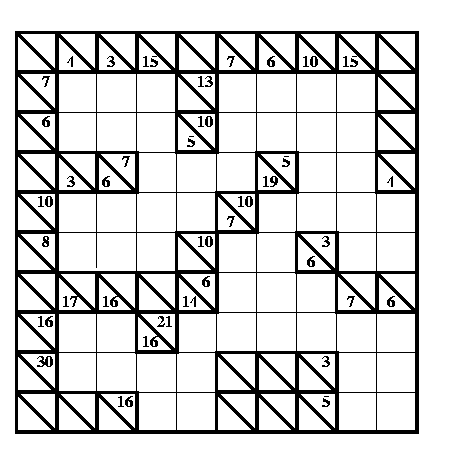
I've always been a fanatic of puzzles and riddles, and eventually that led me to discover Kakuro. I enjoy Kakuro due to the mathematical and logical synergetic nature. I also enjoy the sense of superiority when I compare it to a popular yet very simple puzzle, Sudoku ... which Mindona does. ;D

This is an example of an easy Kakuro puzzle. The objective is to saturate the grid with the numbers 1-9 while making certain that you do not use the same number twice in a given row or column and that all the numbers within a given row or column add up to the given total. Now look at the upper left where you see two rows both with three square. The only way to fit three integers into six is by using the smallest available (1, 2, 3) and to fit three in seven you substitute the three for a four (1, 2, 4). Next, we'll look at the column that calls for two numbers that add up to 4, which will be 1 and 3. Seeing as 7 cannot host a 3, we can tell that a 1 will go in the top box and a 3 will go in the bottom box. Rinse and repeat until solved.

While ones like these are excellent for beginners, do not fear that the difficulty caps off here. There are many puzzles which will require you to look numerous steps ahead in order to deduce which numbers should go where.

I generally do these while eating breakfast and during any periods in which I find myself doing nothing else productive ... such as waiting for Mindona to finish up in the locker room. ;P